Filming coyotes has consumed most of my free time over the last year. While tracking coyotes two weeks ago I found a muddy deer trail bordering some houses and decided to target deer for the fist time in more then 10 years. I was pleasantly surprised to document these giants in some backyards south of Boston. There were 7 different bucks in 14 days and many daylight visits (usually around 7:30AM). I'm looking forward to this location next year when I can deploy cameras much earlier and these bucks will have added some mass to their antlers. I'll also have the chance to look for their antlers this winter.

Monday, December 7, 2020
Backyard Bucks: South Boston Massachusetts

Tuesday, September 3, 2019
Coyote Update
In
February I set out to film coyotes because they have been the most challenging
animal for me to record, even with remote cameras. Three months of tracking
rewarded me with some truly incredible locations to film and the opposite problem: too much footage (15-20Gb a day). I’ll have to
hire someone to help me keep up with it.
I've
been fortunate enough to capture many unique behaviors that have never been
documented and hope to turn this project into something much bigger. Here
are a few screenshots from just a couple videos of the tens of thousands of videos from this summer and spring. Stay tuned!


Monday, July 8, 2019
Coyote Pups at Den
While checking cameras at a coyote den site I noticed two pups crawling around outside the den. I took this video on my phone before quickly redeploying a number of cameras at this site. I haven’t posted any of the footage and will probably post very limited screen shots or short videos, but the footage has been spectacular.
I’ve seen some truly unique and intimate behavior between the parents, pups, and the pups from last year. I watched every coyote documentary I could find and scoured the internet and never seen behavior like this. I learned a lot of lessons for next year too. My biggest problem is keeping up with viewing and cataloguing all the footage. I’m filming about 15GB of footage a day (total) on 25 different cameras so every few weeks it takes 30-40 hours to get through all the footage.
I’ve seen some truly unique and intimate behavior between the parents, pups, and the pups from last year. I watched every coyote documentary I could find and scoured the internet and never seen behavior like this. I learned a lot of lessons for next year too. My biggest problem is keeping up with viewing and cataloguing all the footage. I’m filming about 15GB of footage a day (total) on 25 different cameras so every few weeks it takes 30-40 hours to get through all the footage.
Wednesday, February 27, 2019
Eastern Coyotes Pack
This spring I'll be using remote cameras to record eastern coyote behavior. I've found a number of sites that I hope will provide some incredible footage. Out of all the animals I've filmed, coyotes have always been the smartest and the hardest to capture. This means I will have to build an entirely new fleet of specialized remote camera systems, a feat I hope can be done within the next month. This footage is from a scouting camera that was set for a week. I use scouting cameras to monitor many areas at once before bringing in a higher quality camera.
Please select HD from the gear icon on the video and turn the sound on:
Please select HD from the gear icon on the video and turn the sound on:
Friday, November 2, 2018
Flounder Chasing Bait School on Cape Cod
Similar to the last video I posted, this video shows a flounder following and chasing a simulated school of bait. Once again, I had no idea this interaction happened until I reviewed the footage which shows just how much goes on under the waves that we never know. I think my favorite part is the last few seconds when the flounder glides effortlessly.
As always, select "1080P" quality option from the gear icon on the bottom right of the video.
Thursday, August 2, 2018
Stripers on Cape Cod
I built a camera system to house a GoPro inside an umbrella rig that
simulates a school of shad. The stripers were keyed in on a sand eel
hatch so this was the wrong umbrella rig choice but still recorded some interesting interactions. While we saw no
evidence of fish above the surface, there was a lot happening under the
waves. We were fogged in with only 100ft of visibility so video quality
would be greatly improved on a sunny day. As always, watch in HD.
Wednesday, December 6, 2017
Fall in Northern Vermont
A full assortment of pictures from a recent camera check in Northern Vermont. One remote camera has been taking pictures in the same location for over a year and half with the same batteries. The coyote picture was taken at a new test site along a river bank. It was located in dense growth along a logging path and I was expecting few if any pictures, yet it yielded some of the best results and most diverse species. After all the years camera trapping, I am constantly surprised and continuing to learn.


Tuesday, August 15, 2017

Tuesday, October 11, 2016
Life as a Moose Calf
Moose are born mostly legs but grow rapidly. Their only job is to follow mom around. However, the life of a moose calf is a harrowing ordeal. Only 20% make it through their first year. If they can make it over that hump, they will likely make it many more. Their most formidable opponent is the winter tick. Capturing pictures of these guys every week, I was able to watch them grow up. Only weeks old in the first set of pictures, they will face many challenges, but they continue to look strong and have good habitat.


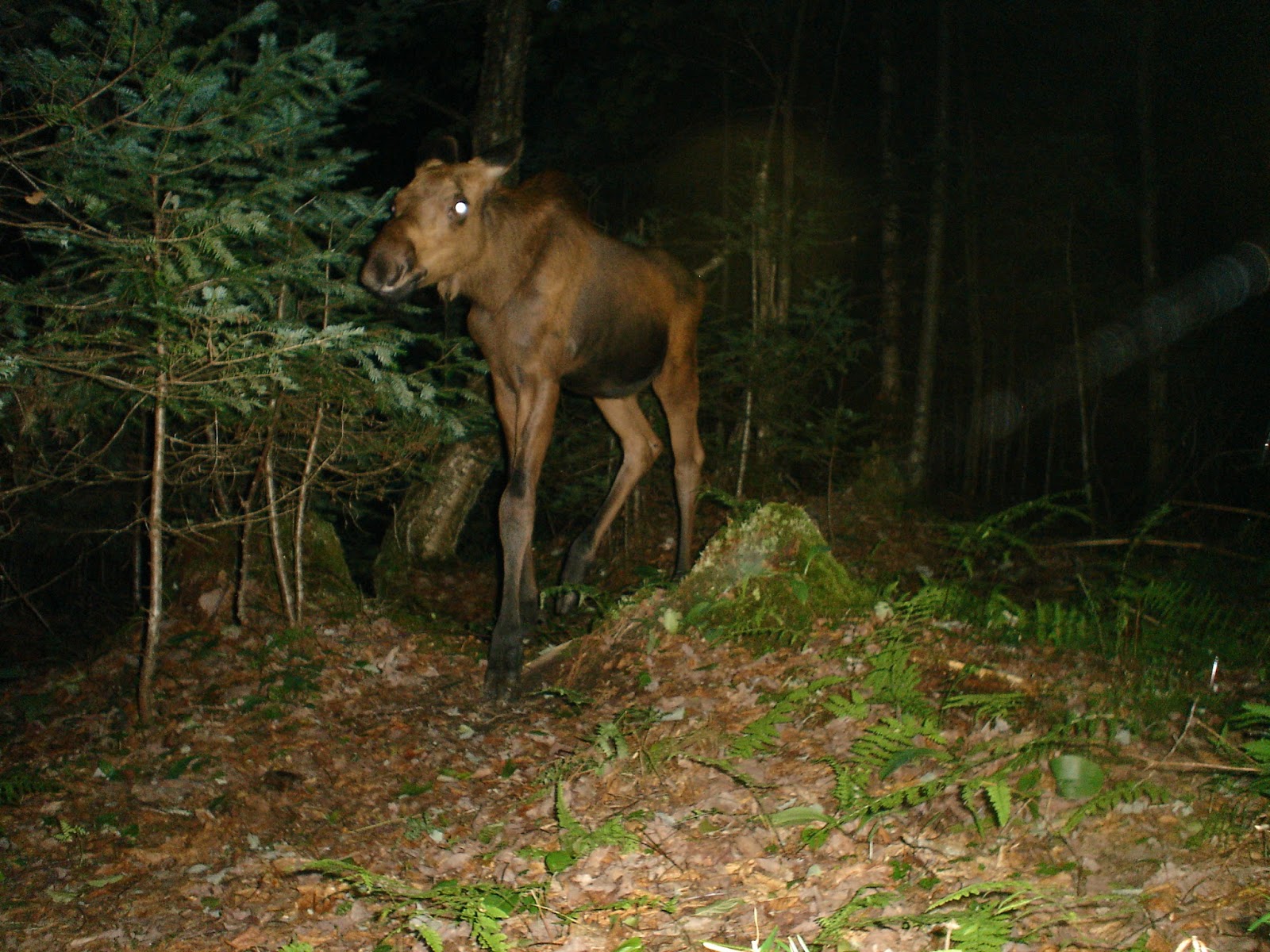


I'm always a season behind with camera trapping because I am only able to check most of my cameras every 3 to 6 months. This pictures sequence starts in early June and runs until September.
Tuesday, September 6, 2016
Bobcat Rolling in the Flowers
Turn to 1080p HD quality, turn up the volume, and watch in full screen. The video is better with sound and at higher quality. The date an time stamp on the camera is incorrect:
Sunday, June 19, 2016
The Secret Lives of Snapping Turtles
Make sure to turn to 1080 HD quality, turn up the volume, and watch in full screen. The video is better at higher quality.
Friday, June 17, 2016
A Little Bit of Everything
Plenty of pictures to go around after the latest remote cameras check in Northern NH and Vermont. Two of the cameras had been deployed for over two years. These are just a few.

Remote cameras and bears mix like oil and water. Almost every time a bear shows up, the camera gets "inspected". You can guess what happens next (taken with an IR camera).

A coyote taking a roll in the snow.

A coyote
pup inspecting a pole with velcro. The pole provides a reference size and collects fur which can be used for DNA analysis. In a show of force, a bull moose snapped the stick at the
base a month after this photo was taken.

Legs for days. A Snow shoe hare showing off.

A porcupine sauntering across the snowy crust.
Tuesday, February 2, 2016
Eastern Timber rattlesnake Hunt
This summer I traveled to Massachusetts to film an eastern timber rattlesnake hunt for a new BBC wildlife documentary series. The series, "Earth's Greatest Spectacles-Changing Worlds", premiers Friday February 5th at 9pm on BBC Two or BBC iPlayer (USA release TBA). I designed, built, and deployed remote cameras with my assistant Luke Barbour to capture the hunt. The link below features a story, pictures, and a teaser from the shoot. Fair warning: It's a snake and a mouse.
http://www.bbc.co.uk/programmes/articles/4cs2MfytzbNQ3lzQxDTVgPQ/filming-an-elusive-rattlesnake
http://www.bbc.co.uk/programmes/articles/4cs2MfytzbNQ3lzQxDTVgPQ/filming-an-elusive-rattlesnake
Wednesday, May 13, 2015
Canadian Lynx in New Hampshire


If a lynx bounds through 18 inches of fresh power in the woods of northern N.H. and nobody is there, does it still make a noise?
Trick question.
With such a low density of lynx in N.H., I truly enjoy the challenge of trying to photograph them. For me, it is the ultimate test to design the right tools (remote camera systems) and combine those tools with the past experience and knowledge of wildlife to predict why/where an animal will be before it gets there.
When working with remote cameras, in particular long term camera sets, if things can go wrong, they will. Moisture in the camera leads to blurry pictures, batteries die, the cold stops components from working, a curious moose or bear moves/steals/punctures the camera only to be found face down or waterlogged months later, and the list goes on. These photos, taken in the winter of 2013, highlight one such success. One lynx, eight pictures, frozen in time.
Saturday, March 7, 2015
Winter Life for the North American Beaver
The above video is a series of short clips taken this winter of an animal extremely well adapted to cold New England Winters. Despite average night-time temperatures of -15 F°, this beaver left it's lodge to forage and was never bothered by the cold. Peak activity was from 1-3am and not one clip was recorded during daylight hours. This is a two minute condensed version from 4+ hours of footage during a one week filming period.
Thursday, February 19, 2015
Weasel on a log

This photo of a weasel was taken at 3:54 am. Weasels are built like a snake, basically just a head and tail. Being long and thin has it's advantages, such as fitting into small holes and spaces to find their favorite prey-mice. It also has its disadvantages...with lots of surface area weasels lose heat quickly and require a fast metabolism to keep warm, which means they are constantly moving, hunting, and searching for calories.
Saturday, December 6, 2014
American Woodcock stroll-video
The video setup was designed to capture large mammals, however I was most amused by the American Woodcock that strolled across the bottom of the screen. There is a certain flamboyance to it's walk as it picked its way through the short grasses on one particularly dark October night.
Video is best viewed full screen and by selecting HD 1080 in the bottom right under the settings wheel.
Wednesday, November 26, 2014
Spruce Grouse in Pittsburg

Friday, July 4, 2014
Moose Selfie

A curious moose photographed in April in northern N.H. While the moose is one of the largest animals in the woods, it's fate often is determined by one of the smallest, the winter tick. Yearling moose in particular face extreme pressure and mortality from winter ticks. Moose are not as effective at grooming as deer and often rub the hair off the chest and shoulder areas where they cannot reach. Excessive rubbing and grooming exposes white broken hair shafts which why many also call them "ghost moose". This particular moose was looking pretty good after a long winter.
Sunday, June 8, 2014
N.H. Winter Coyote


This set of pictures is only a few of many, but the coyote has that look in his eye-a wild look I would expect to see if I curled up on the open ground in nothing but a sleeping bag but had that nagging sensation like I was being watched. Poking my head out I can imagine seeing this face staring back...one to me that is questioning the difference between a threat and a potential meal. Lucky for me, the camera I built was designed for a long deployment. Set on September 22nd 2013, it was still taking pictures on June 4th 2014 when I checked it.
Subscribe to:
Posts (Atom)